Canal
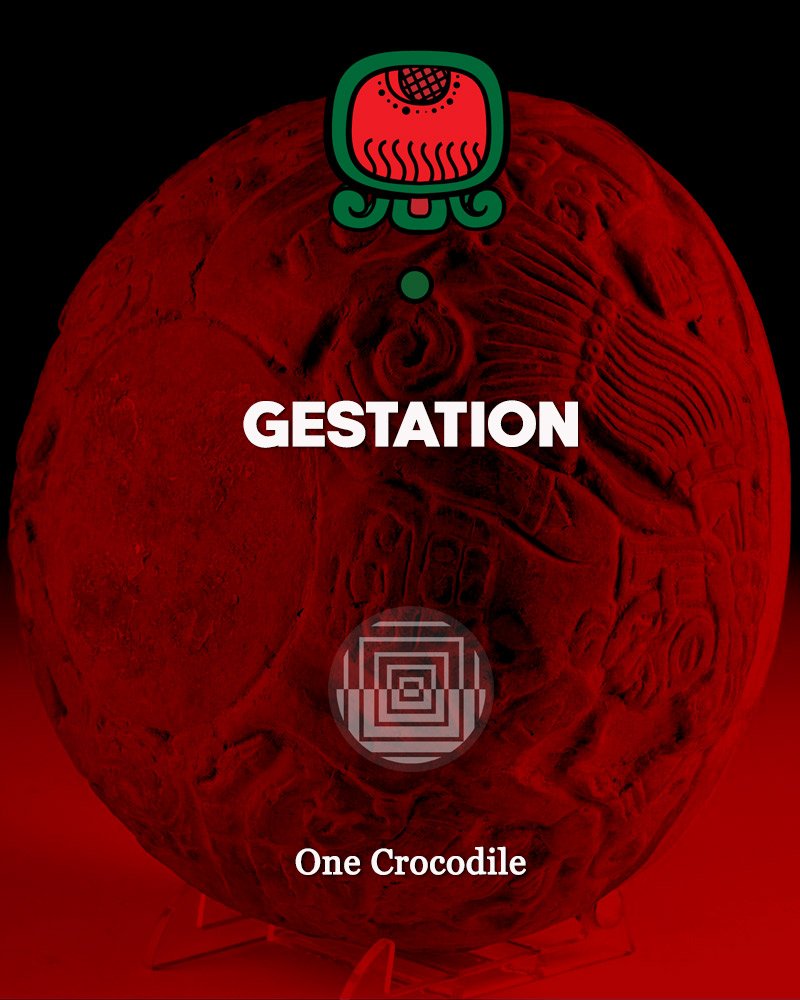
Jun Imox – Gestation
If we take the Cholq’ij starting from Jun Imox and interpret the unique combination of the day, we could conclude that today is the day of birth, of a great new beginning. It seems that certain Mesoamerican cultures chose or deliberately utilized a cycle that began on this day, finding it the most accessible entry point for teaching and understanding the unfolding progression of the nawales. Imox connects directly to birth, emergence, and primal origins; thus, it appears proper that the whole 260-day cycle would begin on this day.
Yet the count we are currently navigating was deliberately chosen to begin with Jun B’aatz as its first day—representing not the initial physical birthing of the cosmos or genesis, but the spark that ignites time itself, the unweaving of time and space. Being complementary partners, Jun Imox and Jun B’aatz are found respectively in the middle of the other count, right at the center. The twenty-day veintena count that begun with Kajib’ B’aatz (4 B’aatz)—and for which today we are right in the middle—should be experienced as a very intense time, the Zuvuya channel described by sketchy José Argüelles.
This time of intensity varies in tone—ranging from luminous to dark, good or happy—depending on its correlation with the solar cycle and with other cycles like that of Venus. For this year in this part of Mesoamerica, we find ourselves very close to the inferior conjunction of Venus and in a time of El Niño, during a part of the year where the tropical depressions have settled permanently over the continent, leaving us with one of the most miserable rain seasons we’ve ever had. If we thought, or someone thought, that today was a time of birthing something new, of starting a new project, of showing ourselves to the world, a moment when finally something would break through and show its light into this world, we were wrong.
It turns out, Jun Imox represents more of a getting pregnant and starting a gestation kind of reading. Curiously, to many cultures, life doesn’t begin when the creature is born out of the birth canal; rather, the spark of life begins a couple of weeks after the being is conceived, when the pregnancy is accepted and the gestation is chosen. In the reptilian world, same thing occurs. The fertile eggs are laid. They are not born yet, but the life is there, the creature is there, living its gestation period. In this manner this reading goes for today and for the coming thirteen days.
Something is going to be born. It is not yet alive in the sense that it can fend for itself; it doesn’t really even breathe. It yet has in that sense no life of its own—it is its own spirit, its own seed or egg—but it is completely dependent on us, that we take care of it and take care of ourselves for it. For this trecena we must look inside us and see if something is there, if something great is gestating inside of us. It is the case for me, but for you it may not be. In that case you can turn to the reading of the sea of nothingness and everythingness. I won’t give two readings here, so if that is your case, you can ask for it personally and I will gladly tell you about it.
This reading then goes for those who look inside and do find something great gestating inside them. A project is in their hands and with it their future. This should be not a little job or something to survive, but something that can actually guarantee the future generations getting the fruits from it. This also should be not something that doesn’t have a life of its own once it is born, a mere illusion or hope. Life is real, and you should bear it.
The key attitude to have with this gestation is, as if you were pregnant, to take care of yourself, don’t strenuate, feed its needs—your own cravings—and give it its time and space. It likes it quiet and dark. If you find yourself traveling too much, partying too hard or stressing yourself to make it (though this last one is to an extent unavoidable due to the sterile system we are forced to live under), it is a strong sign that you are not gestating anything. Quitting and dropping dates or appointments, not getting into new ones and just feeding your inner being and your coming project, should be the way to flow within these new old waters of the Imox nawal.
The business world and even life wants and needs to keep moving. Concerts are held, venues host gatherings, ceremonies are summoned, and yet we will see this reading play out where for some mysterious reason (or not so mysterious if you can read the signs) there seems to be little or no, or at least less attendance to what was expected or is needed. If you flow with this reading, you will expect less from this outer world and know it is not the best time for selling products or for lighting fires.
It doesn’t mean you won’t try it, or that you must stay inside and avoid contact. It means that when you do, things won’t flow as expected. The energy instead of flowing to the living, is flowing to what is going to live, what is gestating, to what is coming. Acting wisely from this flow is knowing to keep the cake in the oven and not opening it every ten minutes to check if it’s already cooked. Trust the scent that will let you know. Meanwhile keep it within, keep its power as a potential, don’t disperse it before it’s time. Every time you push it, you draw energy from it, making it harder for it to be birthed.
This is the time when wanting something better will finally outweigh the fear of missing out.
Not the same being again.
Some things are birthed by those who have birthed them a thousand times over. They are the experts, or so they claim to be. This nawal and this reading teaches us to be different, and to gestate something authentically new. The only way this can be achieved is to recognize that even if you have done something, or someone else has, seemingly in a successful manner a thousand times already, it may just be that it was done completely wrong. I’ve seen it, in the birth of my own first child, how an apparently expert doctor with obstetrician experience carried out the same awful mistake for the thousandth time again. How can you ever tell someone like that, who has done it hundreds of times, that they are doing it wrong?
Something new means not the same old. Accomplishing this requires recognizing that we’ve been terrible at whatever since ever. Today’s nawal invites us to the grandeur of approaching new creations with a completely refreshened view and with a mature enough character that is willing to see how it has done it wrong in the past, recognizing you completely sucked at it, and are willing to try out a completely new approach. The true master creatress acts in this way. She erases civilizations, wipes off entire continents and begins new geological eras to try out a completely new setting for the coming proposal of life. In the same way genius human creators are such because even after decades of supposedly mastering an art, they recognize how shitty their art is and create something new.
Feeling tired and sick of others, of the same old attitude, of the same venues and ways, is a healthy feeling under the light of this trecena’s governing nawal. Master Imox has this grandiose desire to be different, and is better than no one at gestating and pariring products and creations brought by this burning desire. On one side it knows and gestates this feeling well within, being very careful at not letting it hatch outside the egg. On the other side it knows that nothing is created completely from the void, that there is no blank canvas, and that everything new created can only be created from the same old primordial waters. In this balance comes its greatness, its magnificence, its lovable humble grandeur and its magnetic love to give and create more love.
The Primordial Ocean / The Great Mother / Creative Madness / The Receptacle of Potential (Imox) represents the primal waters of creation, the subterranean womb, the subconscious mind, artistic genius, and the untamed reservoir of raw potentiality from which all form emerges. It is the nawal of deep intuition, sensitivity, origin, and the fertile chaos that precedes structure. In its first position (Jun), it acts as the primal seed, the initial spark of initiation, the opening pulse of the wave, and the foundation upon which the entire 13-day trecena is anchored.
To embody One Imox is to hold the primordial egg without breaking its shell. It demands that we protect the hidden spark of creation while it rests in the generative darkness, resisting the temptation to drag it into the light before its time. At this foundational threshold of the trecena, Imox calls us back to the deep waters of origin, urging us to trust the quiet, invisible process of gestation. It reminds us that before anything can walk, breathe, or stand in the sun, it must first be held, nourished, and allowed to dream itself into existence within the silent womb of the cosmos.
RESEARCH
1. Imox (Highland Maya / K’iche’)
In Highland Mayan languages, Imox (pronounced Ee-mosh with a glottalized initial and soft palatal x) is the 1st day sign of the Cholq’ij cycle when calculated from primal origins. It is the nawal of the primordial sea, the womb, subconscious depth, creative madness, intuition, and raw potentiality.
Etymology & Morphological Structure
- Im / Imox (Root Noun): Water lily, female breast, milk, or primal water.
- Mo’x / Moxil (Adjective / Abstract Form): Left-handed, eccentric, unusual, non-linear, or receptive/intuitive state (mox).
- Im-ox (Literal Translation): “The water lily,” “that which floats on the primordial sea,” or “the left hand of creation.”
- Etymological Link: Directly tied to I’m (breast/nourishment) and Mox (left-side/unconventional thinking), signaling the primal nourishment that feeds creative genius before logic imposes structure.
Core & Literal Meanings
- The Primordial Waters & Cosmic Womb: Represents the universal ocean (Uk’u’x Plo) from which all physical land and life emerged.
- Receptivity & Non-Linear Mind (Creative Madness): Symbolizes the subconscious, dreaming, artistic inspiration, and the unstructured mind before dualistic logic organizes it.
- Gestation & Origin: The hidden state where a seed or fetus absorbs nourishment in silence and darkness, holding immense potential energy.
Uses in Everyday Speech (Common Language)
In everyday K’iche’ and highland speech, Imox and its roots function across anatomy, psychology, and nature:
1. Physical Anatomy & Nature
- Im: “Female breast” or “milk.”
- U-tux imox: “The water lily bud” or “the root of the water plant.”
- Uk’u’x plo imox: “The deep marine waters / sea level.”
2. Psychology & Left-Handedness
- Mox: “Left-handed” or “left side” (e.g., u-mox q’ab’ = left hand).
- K’o u-moxil: “He/She is eccentric, unconventional, or operating on pure intuition.”
Uses in Ceremonial, Esoteric, and Idiomatic Discourse (Specialized Language)
In daykeeping (Ajq’ij tradition), artistic creation, and water rituals:
1. Sacred & Temporal Terminology
- Rajaw Imox: “The Guardian Lord of the Ocean, the Subconscious, and Primal Creation.”
- Uk’u’x Ya’ Imox: “The Heart of the Waters” (invoked at springs, lakes, and oceans during rain petitions).
- Jun Imox (1 Imox): The opening portal of the trecena—the pure seed of gestation and hidden potential.
2. Metaphorical & Idiomatic Expressions
- U-moxil k’aslemal: “The creative madness / dream-state of life” (the artistic impulse that breaks rigid societal rules).
- R-och’och ya’ Imox: “The aquatic womb” (the subterranean waters where souls gestate before birth).
2. Imix / Imix’ (Lowland Yucatec / Classic Epigraphy)
In Lowland Yucatec Maya and Classic Epigraphy, Imix (or Imix’) carries primary roots in water lilies (Naab), cosmic earth-crocodile back, female breasts, and foundational nourishment.
Etymology & Morphological Structure
- Imix / Imix’ (Noun Root): Water lily, maize grain, or nourishment source.
- Im / Tam (Cognate Roots): Deep, profound, or breast/milk.
- Classic Glyph Symbolism: Depicted as a stylized water lily pad or a vessel holding liquid/maize with dots representing drops of water or seeds of life.
Core & Literal Meanings
- The Cosmic Water Lily (Naab): The floating water plant that sits at the boundary between the watery underworld (Xibalba) and the physical surface world.
- The Primordial Reptile / Earth-Crocodile (Itzam Kab Ain): Associated with the great crocodile floating on the primal sea, upon whose back the earth was formed.
- Mother’s Milk & Primary Food: Symbolizes the foundational substance that sustains new life during its earliest stage.
Uses in Everyday Speech (Common Language)
In Yucatec Maya, terms related to Imix connect to water plants and depth:
1. Botanical & Environmental Terms
- Imix-há: “Water lily” (literally: Imix of the water).
- Tam-il: “Depth” or “deep water.”
- Im-i-ch’och’: “Nourishing sap / milk of plants.”
Uses in Ceremonial, Esoteric, and Idiomatic Discourse (Specialized Language)
In Yucatec ritual tradition and Classic monumental inscriptions:
1. Sacred Roles & Epigraphic Phrases
- Yax Imix: “The First Water Lily” or “Primal Abundance” (frequently used in creation texts on stelae to mark the beginning of time).
- Itzam Kab Ain: “The Earth-Crocodile of Imix” (the primordial sea monster that was defeated to establish firm land).
2. Metaphorical & Idiomatic Expressions
- U-wi’il Imix: “The root/fruit of origin” (referring to ancestral lineage and the deep source of sustenance).
- Imix-en-ol: “A mind as deep as the primordial sea” (unfathomable intuition and vast creative capacity).
3. Sipaktli / Cipactli (Central Nahuatl / Aztec Cosmovision)
In Central Nahuatl and Mexica cosmovision, Sipaktli (or Cipactli, pronounced See-pahk-tlee) translates to the primordial alligator / earth-monster, crocodile, or thorny marine dragon. It is the very 1st day sign of the 260-day Tonalpohualli calendar.
Etymology & Structural Symbolism
- Sipaktli (Root Noun): Alligator, crocodile, or spiny water monster.
- Tlaltecuhtli Connection: Associated directly with the earth-monster deified as Tlaltecuhtli, whose body was torn apart by Quetzalcoatl and Tezcatlipoca to form the sky and the terrestrial world.
- Glyph Symbolism: Depicted as a green alligator head with a gaping jaw, jagged teeth, and a spiny crest, symbolizing an insatiable womb and devourer of organic life.
Core & Literal Meanings
- The Primal Marine Monster: The untamed, ancient sea creature living in the primordial chaos before order was established.
- The Fertile Earth & Genesis: Because the physical world was sculpted from Sipaktli’s body, every plant, mountain, and river sprouts directly from its flesh.
- Raw Appetite & Vital Energy: Represents the primitive, instinctual urge to eat, digest, absorb, and generate life—unconscious yet wildly fertile.
Uses in Everyday Speech (Common Language)
In classic and spoken Nahuatl, Sipaktli appears in zoological and geographical references:
1. Animals & Natural Features
- Sipaktli: “Alligator” or “crocodile.”
- Sipak-tlan: “Place of crocodiles” (common Mesoamerican place name).
- Sipak-kwawitl: “Thorny tree / crocodile-skin bark tree.”
Uses in Ceremonial, Esoteric, and Idiomatic Discourse (Specialized Language)
In Mexica codices, creation myths, and astrological readings:
1. Sacred Cosmological Concepts
- Ce Sipaktli (1 Alligator): The absolute first day of the 260-day calendar cycle—the threshold of creation, primordial initiation, and unmatched cosmic fertility.
- Tlaltecuhtli-Sipaktli: The Earth Lord/Lady in reptilian form who demands offerings to feed the soil that feeds humanity.
2. Metaphorical & Philosophical Expressions
- In Ikamach Sipaktli: “The jaw of the crocodile” (metaphor for the entrance to the underworld, the birth canal, or the devouring mouth of time).
- Sipak-tonalli: “The reptilian soul-spark” (referring to deep primal instinct, unyielding survival drive, and raw creative force).
